Saturday, April 17, 2010

Another Brick In the Wall...


I have wanted to take a picture of this sign for so many months, but I just never got around to it. Now, thanks to this assignment it all has come full circle and made sense. I mean how true is the statement? And by being graffiti it demands to be viewed in a way. This artist won't be held back or bound by conventions and gallery showings, but is breaking free of boundaries.

Monday, April 5, 2010

Cookbooks Can Be Difficult To Read


I love to read cookbooks. It's a hobby I inherited from my mother, and she from hers. If I close my eyes and think about my mom my first thought is of her sitting in the living room on a sunny morning with a cup of coffee in hand and a cookbook on her lap.
Cookbooks are fun to read because they provide inspiration. I like to spend a Sunday morning thinking about what I'm going to cook for dinner that evening. Does that seem strange? Well, it shouldn't. After all, don't other artists often use books to find their inspiration?
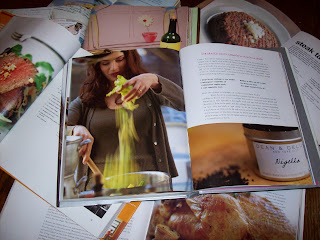
Like other texts, cookbooks are not all created equal. First of all, some don't have pictures. This, I find ridiculous. Every good cook knows that we eat with our eyes first. As an avid reader, I am accustomed to using my imagination, but for me, a cookbook without pictures just will not do. Second, the language used often varies. For example, in the picture above you will see one of my favorite domestic goddesses, Nigella Lawson, stirring cabbage into a pot. Nigella employs a relaxed voice in her writings. She advises readers to, "put the oil in a pan with the garlic and anchovies and cook over a low heat until you have a melted, muddy mess." Or, "cook the salmon over medium-high heat until just cooked through, and remove them to warmed plates while you get on with the vegetables." To me these directions are understandable. After reading, I would get out my non-stick, put in a teaspoon or so of oil and cook the salmon on each side for about five minutes. I would then use an oven-mit to remove the plate that I had previously put in a 200 degree oven (because I read ahead, of course) and, using a rubber, not metal spatula, place the salmon on it. Is that what you would do? Is that what your dad would do? How about your average fifteen year old?
Nigella knows her audience. She is aware that if you purchased her book, you've probably been cooking for a while. That, or you don't ever plan on cooking, but enjoy her writing style. Even though her directions are very straight-forward, they are not thorough. Thus, they are not written for beginners.
Additionally, cookbooks use other language that may be confusing for newbies. For example, do you know the difference between a dice, a chop, and a slice? How about a cup of almonds, chopped, versus a cup of chopped almonds? There is a difference, and not knowing it could seriously alter a recipe.
My point is, like the textbooks we've been analyzing, cookbook writers don't all use the same language. Like in our content areas, there is universal language that cooks should learn before diving into a recipe. However, the way this vocabulary is presented and used is going to be different with all authors.
In conclusion, when shopping for cookbooks (textbooks), cooks (teachers) should search for books with tantalizing pictures (good visuals that accompany learning), and language that makes sense to the reader.

Tuesday, March 23, 2010

Spatial Literacy


The development of mathematical literacy hinges upon a spatial understanding of the three dimensional world. These photographs portray an aspect of math literacy, called spatial literacy, which revolves around the way humans see the world and in turn, the way humans represent this 3D world mathematically. Understanding mathematical concepts through representations (symbols, graphs, diagrams, maps, words, numbers, etc. ) is pivotal to math literacy.

One such representation, a map, displays a relationship between independent elements, or variables, and a dependent variable. Typically, the use of maps in math link a place (the independent variable) to a characteristic of that place. Thus maps are directly related to the study of functions. In conjunction with a scale, maps can be used to visualize our understanding of the scientific qualities of the Earth. The creation of the spherical globe is a perfect example of how humans have developed and used maps to understand and visualize our world more accurately. (Remember, humans used to believe that the Earth was flat!)

These photographs depict a particular type of map, called a contour map. Contour maps display a function of one or more variables at constant output values. The most common type of contour map is an elevation map, which displays the height of the land in relation to locations. However, many types of contour maps exist. The photograph above left is the most readable contour map, requiring the least amount of experience and background knowledge. Located in the University of St. Thomas' Geology department, this is the first printed geological map of Minnesota, showing the location of the various types of rock in the state. Upon reading the scale, the viewer understands that the colors correlate to the type of rock. She must simply look at the map to determine where these rocks exist in order to "read" the map. While most of us have seen contour maps depicting elevation, temperatures, weather patterns, or geological composition, our understanding of what these maps represent in our 3D world often times have not been developed. In other words, we may be able to "read" such maps, but do we truly understand what they represent and where they came from?

The photograph on the right might help to fine tune this understanding. Displayed is a computer screen with an incredible computer program entitled Mathematica. Just like the languages of math and french, for example, computer programs require a sophisticated and accurate use of language, requiring yet another system of translation between one concept or representation to another. This system of language enables students to visualize math concepts in a more concrete manner. For example, the top three images depict three different vantage points of a function of two variables, resulting in a ribbon-like graph. Imagine this function depicts elevation. What is the land doing here? Is it flat land? Or is it rolling hills? After making your conjecture, study the map just below these three images. Can you guess how this relates to the first three graphs?

As you may have guessed, the bottom graph shows a contour map of the original function, and the varying colors play a crucial role in reading this graph. While the contour map makes the land look flat, the colors indicate that the elevation indeed is changing. If an individual had never seen a contour map before, however, she might guess that the land indeed is flat. This shows how important being able to decode and read maps is in the development of spatial literacy, the ability to view the 3D world through various representations, and hence, in the development of math literacy.

Monday, March 22, 2010

Missing someone gets easier every day because even though it's one day further from the last time you saw each other, it's one day closer to the next time you will. ~Anon

Ok, so the first picture may be difficult for you to see, but these are pictures of my friend, Kyle, and his facebook page. Last week, Kyle died and it has been weighing on me very heavily. I have known Kyle since I was in preschool, he was one of my favorite people, and one of the best people I know. One reason I chose to do my photovoice on Kyle this week is because he is very much on my mind right now. I also feel that this is, in some way, a small tribute to my very good friend who I have not talked to or seen in far, far too long and is now gone. (I am grateful that I feel comfortable enough with all of you to share this.)
But how does this connect to literacy? Well, since Kyle has been on my mind lately, naturally I was thinking of him when I had to create this photovoice. I see many ways to connect literacy to these two pictures, as well as to the events that have taken place over the last week. If you could look more closely at the picture of the facebook page, you would see that his wall is filled with posts from after his death. As people found out, many went to Kyle's facebook page to post comments to him. Though Kyle will obviously not be able to read them, people have been writing for a week now, all addressing him as though he will soon log on and read all of them. For many people, including myself, this is a cathartic process that we need to go through. In order to understand our feelings such as grief and confusion, we all chose to write and, in a sense, to talk to Kyle. (I, in fact, found myself talking to Kyle before going to sleep the night he died.) Language is a powerful way in which we understand the world around us. If you were to look at the posts, you would see that some of them merely say "I miss you," "I love you," or "the world will never be the same without you," all true sentiments. However, some of the posts share stories, pictures, or links to videos of Kyle. Not only do we feel the need to write and speak, we also share our pictures and memories through visual representations. Most of Kyle's friends, including me, changed their profile pictures to ones including Kyle. His death has reminded me that there are so many ways in which we have chosen to preserve his memory and also to cope with his death. These are all ways in which we are using literacy to navigate this diffucult time.
Furthermore, this experience reminds me that the forms of literacy are changing. When I first found out about Kyle, it was in a text message from my friend, Pat, who had heard about it from another friend. Kyle arrived at the hospital around 2 on Wednesday morning and I knew about it by noon. He died at 5:30 pm and I found out at 7:30. His obituatry was not in the paper until Sunday, but I knew on Friday when his wake and funeral were going to be because my friend, Dan, had posted it on his facebook. All of this was information that, at one time, would have taken a long time for me to receive (I may not have known about Kyle for days after his death instead of the day of), but because of new technologies, all of this information came to me rather quickly. The way that people interact with the world, and even their own feelings, has changed because of changes in forms of literacy.
For me, writing this photovoice has been helpful because I am able to share my grief with all of you through writing. But I am not merely writing a journal on paper that no one will read, I am having a conversation with you that you may or may not choose to join in on through the use of this blog, a newer form of writing and also speaking.
Because I am using this photovoice as a tribute to Kyle, I will conclude this entry by giving you a link to a youtube video made in the memory of Kyle. He was funny, sweet, smart, and a great person, all of which you can see a small part of if you choose to follow the link. http://www.youtube.com/watch?v=NaBzs1Mc0F4&NR=1


This is a picture of some of my athletes at Acceleration Minnesota. It is their first day of training with us and I asked them to read the warm-up that was posted on the wall. As you can see, they are reading the text on the page, but there are definitely some confused faces. While they are athletes and have been very physically active, the words on the page do not make sense. What you don't see is me helping them through the warm-up and showing them how to do each exercise correctly.

In physical education, stations are a great way to keep the kids active as well as incorporate literacy in my classroom. One of the most important things about stations is that you show the kids what each station is so they have an idea of what they are doing. At each station, there should still be a written explanation so they can refer to it and make sure everyone knows what is going on at that particular station. If someone in the group doesn't remember what to do, they can either read the directions, or someone else in the group can explain it to them in their own words. This explanation could be verbal or could be a demonstration, both, which are parts of literacy.

Stations encompass a big part of literacy including ready, speaking, and listening. Sometimes it is helpful when student "teach" each other because they are able to use their own schema to explain what is desired by the teacher. There are times where some students will pick up on an exercise right away while others may struggle. This gives the students who understand the opportunity to show it through teaching the students who don’t understand it.

While literacy can be found as text on a piece of paper, it is definitely more than just that. In physical education, we see literacy in many different forms. Following directions shows me as a teacher that they were listening or reading and understanding what was being asked. Students don't always realize they are using literacy in physical education because they aren't necessarily reading a book or a study guide. When students are working together in a group, they are communicating and building literacy skills. For me, as a teacher, stations with posted directions will be a great way to incorporate literacy into my lesson without taking time away from the actual physical activity.


This is my grandma: Elouise Ethel Laverne Holmquist. For the last few years, I have watched as my grandma's Alzheimer's has swiftly taken away her ability to make new memories. That's the thing about Alzheimers-- it allows you to remember obscure details of the past, but it makes it hard to remember what you did that morning, or that your husband has been gone for 11 years. I chose to show you two pictures--one that has my grandma in it so that you can see how lovely she is, and one that shows a picture that she painted while we were using some watercolors one day.
We have the newspaper delivered to her everyday now. I think that the familiarity of it--the black and white images, the typeface, the texture, the bold headlines--all provide a sensory experience for her that allows some routine back into her drifting, lonely days.
Sometimes I try art-related activities with her to see if this different form of communication will allow her to recover some of her lost memory, or just to have some stimulation introduced into her day. The first thing I tried was something called Reminiscence Therapy. It's very simple in theory; basically, you use visual representations of the past to evoke conversation and to recall memories. Since those who suffer from Alzheimer's are often able to recall their childhood with more ease then their present, it can be a calming activity for them. You can do something like a shoe box filled with things that would remind them of the era that they grew up in; or, you can put together a photo album of pictures that include images of the person that you are showing the photographs to. The photo album was the path that I chose to take. It brought me great happiness to see that my grandma was healthy and happy at one point, and I think it made my grandma happy too.
The second thing I tried can be seen above in the painting that my grandma made. I wasn't sure how painting would go--I'm not exactly comfortable with paint myself, but since my grandma was more nervous about it than I was, it was easy to pretend like I knew what I was doing. I think I painted a tree...my fall-back idea. My grandma, however, started with a house. She started painting the house while viciously critiquing her work. (Now you see where I get it.) She then moved to making jokes about her house. I don't know if you can read it, but she painted the words "No less than 1 million bucks" in reference to her painted home. After this, she pushed her painting away, and then soon pulled it back to write "failure" (underlined and in red) at the bottom of her painting. I felt sad to see this. I suppose I shouldn't be surprised seeing as how I know how hard my grandma is on herself, but I don't think that she would have ever said that out loud.
As someone going into art education, I know that there is a very good chance that I will learn things that will make me very sad (or angry) about my students' lives through their artwork. Even though it scares me, I feel privileged to be in a position that allows me to work for change.

I thought it was a very nice house that my grandma painted.

World Sports


I was fortunate enough last Friday to get the opportunity to preview the new Target Field. This is the scoreboard of that beautiful new ball park. While looking around and reflecting on how much I love baseball, I thought about all of the different sports there are in the world and how many of them differ from one place to the next.
But, as we saw with the Olympics this year, many different countries play the same or similar sports. While I don't know the rules to cricket, I've seen it played. It is a similar bat and ball sport to baseball. Another example of similar sports is le petanque in France is similar to bowling.
What does this do have to do with literacy? Plenty. Just look at this scoreboard and you'll understand. Pretend that you are from a different country and you go to a baseball game. You are unfamiliar with baseball but know that it is nicknamed the great American pastime. When you get to the field and the game starts, you are completely lost. You look to the scoreboard for help and you don't understand that either. On the left of the screen you might notice that next to Cuddyer (which you deduce is a player's last name) it says RF. What does that mean? and why are two of the four squares yellow in the little diamond diagram on the top of the screen? As you watch, you start to understand that if a ball is caught, the player who is running has to leave the field but you still don't know how the game is scored or why the guy (who you can only assume is some sort of referee) is being yelled at by 40,000 fans. You would have very little idea what is going on unless someone who was baseball-literate was there to explain it to you.
This same idea can be transferred to literacy in a foreign language. You can look at words and make certain assumptions that may or may not be right. These connections are an important learning strategy, even if they are wrong. However, the fact is, unless you have someone there to explain some things and help you understand, you will rarely ever become fully literate.
P.S. For any Twins fans out there, I thought this would be a nice tribute to Joe Nathan (the guy on the screen) who is not with us this season due to an injury. I am very sad, but hope he will be back next season.